

Rebuilding Local News with a Model Meant to Last
The American Journalism Project is investing in local newsrooms like Capital B, demonstrating what newsrooms can achieve when they prioritize trust and service to their communities.
For Surdna’s 2025–2026 Living in the Future Impact Report, we partnered with Next City, whose journalists covered the work of eight of our many extraordinary grantee partners and investees. Chosen from hundreds of impactful efforts this year, these stories show that despite the recent backlash against racial progress, our partners are not waiting for a just and sustainable future; they’re building it now.
Rebuilding Local News with a Model Meant to Last
By: Brujo Betancourt | Next City
Capital B was built as a digital newsroom, but when its journalists got to work in Gary, Indiana, people kept asking about the city’s once-thriving newspaper, long since faded.
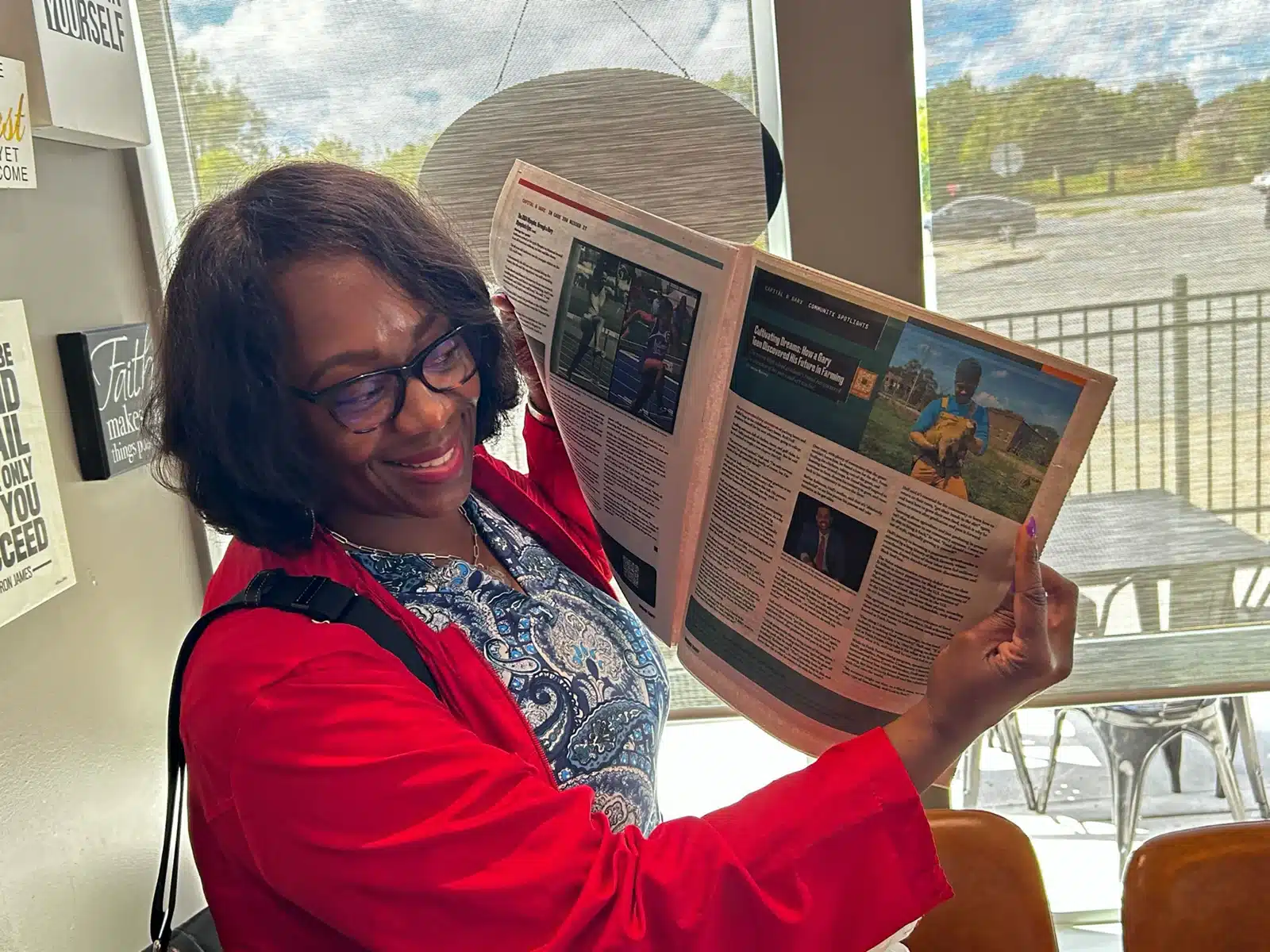
In a city that struggles with broadband access, digital news was out of reach for some residents. So Capital B listened and began printing Gary Monthly, a free paper with stories already published online. About 5,000 are printed each month and placed around the city, including at the library, university, the main transit center, and a popular breakfast spot where copies don’t sit around long.
“We end up having to fill them multiple times a month because people really, really enjoy it,” says Capital B co-founder and CEO Lauren Williams. Some business owners have cut out stories about themselves and hung them on their walls. “It’s really become a meaningful part of what we offer, and it’s been huge for building trust in the community.”
For Williams, that response is one of the main reasons Capital B exists in the first place.
Before helping build the nonprofit newsroom, Williams had spent about 20 years working across journalism. She spent her time at places like AOL Black Voices and The Root, and later helped build Vox during its early years. But by 2020, Williams saw an industry in trouble. Local news organizations were shrinking just as trust in national news was strained. At the same time, journalism leaders were figuring out how to save an industry that had lost jobs, readers, and money. And Williams worried Black communities would be left out of whatever came next.
“There are lots of people thinking really hard about how to save news, and I really needed Black communities to be part of that conversation,” she says, noting that COVID-19 hit Black and Brown communities the hardest. And protests following George Floyd’s murder had forced a national reckoning over race and power.
The news media infamously covers Black communities only when disaster strikes. They cover racism and problems, mostly reaching white audiences, says Williams. Capital B was founded to ensure people who need information about their daily lives were actually being served.
“We do journalism that is about Black communities — but for Black communities,” says Williams.
Williams and co-founder Akoto Ofori-Atta began writing up a project brief while still working full-time jobs. They called it “Project X” because their newsroom still didn’t have a name.
“We only had an idea,” Williams says. “We didn’t have a lick of money.”
Then they met John Thornton, co-founder of the American Journalism Project, who connected them with Sarabeth Berman, AJP’s CEO. To help turn the idea into a newsroom, AJP gave Williams and Ofori-Atta an early grant that enabled them to leave their jobs, begin raising money, and build a business plan.
“It was the combination of their leadership and their idea,” says Berman of the decision to back Capital B.
Launched in January 2022 with nine employees, Capital B now has about 30 employees across a network that includes local newsrooms in Atlanta, Georgia, and Gary, Indiana, a national desk, and an upcoming newsroom in Augusta, Georgia.
As is its practice, the first AJP-funded positions were in revenue and operations. Not only that, but AJP also works with news organizations on fundraising, audience growth, advertising, sponsorships, financial planning, and technology. The growth of Capital B exemplifies the results AJP hopes to multiply across the country.
“This is not just about funding quality journalism, but funding quality journalism that can endure,” Berman says.
The American Journalism Project began in 2019 as a “venture philanthropy” focused on revitalizing local news. AJP invests in nonprofit news organizations, focusing heavily on something many journalism grants do not: the business side.
Since launching, Berman says AJP has raised over $270 million and built a portfolio of more than 50 nonprofits working in more than 100 communities across 38 states.
The newsrooms it supports have reported 28% revenue growth, generating $160 million in revenue in 2025. She says the income has powered full-time newsroom staff to expand by 23% in the past year. That growth, Berman says, is part of rebuilding an industry that’s been shrinking for years.
“Over the last two decades, we’ve watched the unraveling of the American local news industry,” she says, noting that “75% of journalists have lost their jobs.”
Adding reporters back into communities matters, Berman says, because they provide information residents rely on to vote, understand their government, and make decisions about their daily lives.
“The growth of these news organizations is a real source of optimism for our country,” says Berman. “We are living in a really challenging information ecosystem, and original reporting is the plankton that feeds the sea of our information ecosystem.”
The AJP strategy also caught the attention of the Surdna Foundation, which first added its support in 2024 with a $150,000 grant spread over three years. The more than 100-year-old foundation is building just and sustainable communities by operating across areas including the economy, culture, climate, and youth justice. And supporting media is like girding the infrastructure needed to advance every part of the work. Surdna had already backed some of the same news organizations that work with AJP, including Capital B, MLK50 in Memphis, and ICT, which serves Native communities.
“In journalism, we are particularly drawn to people and programs where they see the work as a public good,” says Elizabeth Cahill, vice president of communications and engagement for the Surdna Foundation. AJP is part of a dramatic expansion of nonprofit news, with the number of newsrooms tripling since the organization launched in 2019. She says what also stood out was AJP’s focus on helping newsrooms survive as businesses.
“AJP listens to communities to understand what they need,” Cahill says. “They realize that journalists and newsrooms are really good at doing journalism, but the business of it, which has been so challenging, is tough and is ever-changing.”
She says AJP’s investments last long enough for a newsroom to grow roots and serve its community.
“You can’t do it without long-term investment,” Cahill says. “Seriously, people need a runway and support to get started.”
The numbers measure growth one way, while the journalism shows what growth can mean to the communities they serve. When residents in Gary, Indiana, experienced a historic electricity blackout this summer, Capital B’s journalists worked and lived through the crisis, and the likes of BBC and NPR featured their reporting.
In Atlanta, for example, Capital B investigated dangerous conditions at an apartment complex called Fairburn & Gordon. Residents were living with holes in bathroom floors. Children struggled to breathe because of mold, while Williams says residents felt ignored.
A Capital B reporter went to the complex, recorded video, and published it online. The video spread widely on TikTok. The reporting eventually drew the attention of the U.S. Department of Housing and Urban Development. When HUD’s inspection found violations, Williams says, families receiving housing assistance were moved into safer housing.
“Ultimately, the families that were in assisted living, living there, all got moved into better, healthier housing,” Williams says.
Producing impactful work, she says, depends on relationships built long before a story gets published. Trust thrives only when reporters are part of the community, have roots there, and continue showing up for the people.
For Cahill, that kind of local journalism creates something bigger than a single story: community power. “It creates pressure, it creates accountability,” says Cahill, “and it gives voice to people whose voices were being ignored.”